516-812-0917
 Help
 Live Chat







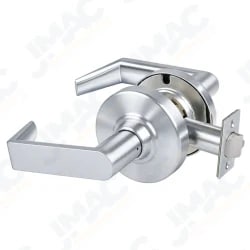
The Schlage ND73 is the corridor lock function (ANSI F90) of the ND Series, Schlage heavy duty Grade 1 cylindrical lock. A key cylinder in the outside lever and a push button in the inside lever give the opening two ways to lock, and they behave differently on purpose.
Lock with the button and it is temporary. Rotating the inside lever releases the button and unlocks the outside lever, and closing the door also unlocks it, so nobody gets stranded by a door that locked itself behind them.
Lock with the key from outside and it holds. The inside lever still retracts the latch so people can leave, but the outside lever stays fixed until a key unlocks it from outside. The button and the inside lever cannot undo it.
That split is what makes it the corridor function: casual day to day locking that self-clears, plus a deliberate key lock that stays put until staff return. Note that unlike the ND50 and ND53 entrance functions, on the ND73 the outside key does lock the door. The inside lever is always free for immediate egress in every state.
It takes conventional, FSIC, or SFIC cylinder formats and defaults to the patented Everest 29 S123 keyway, with 3,100 in-lb of abusive lever torque resistance (2.6x BHMA) and near zero droop and wobble after 16 million cycles (16x BHMA) behind it.
Features
- Corridor lock function - key cylinder outside, push button inside, deadlatch.
- Two ways to lock - push button for temporary locking, key outside for locking that holds.
- Locked by button: rotating the inside lever releases it, and closing the door also unlocks, preventing lock-out.
- Locked by key: the outside lever remains fixed until unlocked by key outside.
- The outside key locks as well as unlocks, unlike the ND50 and ND53 entrance functions.
- Inside lever always free for immediate egress in every state.
- In the unlocked state the latch is retracted by either lever.
- Conventional, FSIC, and SFIC cylinder formats, plus less-cylinder options for existing key systems.
- Patented Everest 29 S123 keyway standard on conventional and FSIC cylinders.
- Keyed different, keyed alike, master keyed, or construction keyed.
- ANSI/BHMA Grade 1 certified to A156.2-2011, Series 4000.
- Resists 3,100 in-lb of abusive lever torque, 2.6 times the BHMA requirement.
- Restricts entry against 1,600 lbs of offset lever pull, 8 times BHMA.
- Near zero droop and wobble after 16 million cycles, 16 times BHMA, with no set screws or O-rings.
- Nine ADA compliant lever designs and nine finishes; inside lever can differ from outside.
- Non-handed; UL Listed 3 hour fire rated and BAA compliant.
Specifications
Function
- Schlage Function
- ND73 corridor lock
- ANSI Function
- F90
- Trim
- Lever with key cylinder outside; push button in the lever inside; deadlatch
- Unlocked State
- Latch retracted by either lever
- Locking
- Outside lever is made inoperative by pushing the button on the inside lever, or by key outside
- When Locked by Pushed Button
- Rotating the inside lever retracts the latch and releases the button, unlocking the outside lever. Closing the door also unlocks, preventing lock-out
- When Locked by Key
- Rotating the inside lever retracts the latch, but the outside lever remains fixed until unlocked by key outside
- Egress
- Inside lever always free for immediate egress
- Cylinders Required
- One, outside
Cylinders and Keying
- P6
- Conventional 6-pin cylinder, Everest 29 S123 keyway
- P
- Conventional 6-pin cylinder keyed 5-pin, Classic C keyway
- L
- Less conventional cylinder, for supplying your own
- R
- FSIC 6-pin full size interchangeable core
- J
- Less FSIC core, for an existing full size interchangeable core system
- H
- Refundable construction SFIC core
- B
- Less SFIC core, for an existing small format interchangeable core system
- Keying
- Keyed different (standard), keyed alike, master keyed, or construction keyed
- Default Keyway
- Everest 29 S123 on conventional and FSIC cylinders. Master keyed systems default to Everest 29 S145
- Pack Cylinders Loose
- PCL available if cylinders should ship uninstalled
Performance
- Abusive Lever Torque
- 3,100 in-lb, equivalent to over 690 lbs at the end of a 4-1/2 inch lever (2.6x BHMA)
- Offset Lever Pull
- 1,600 lbs (8x BHMA)
- Vertical Impact
- 100 impacts with no failure or indication of stress (20x BHMA)
- Cycle Life
- Near zero droop and wobble after 16 million cycles (16x BHMA)
- Latch Preload
- Latch retraction with 200 lb preload (4x BHMA)
Chassis and Trim
- Chassis Material
- Modular design of zinc and steel components, plated for corrosion protection
- Handing
- Non-handed
- Door Thickness
- Standard 1-5/8 to 2-1/8 inches. Optional 1-3/8 inches to 6 inches in EE, EO, EI, and ED configurations
- Backset
- Standard 2-3/4 inches, with 3-3/4 inch latches available and a 5 inch backset extension
- Lever Designs
- Athens (ATH), Boardwalk (BRK), Broadway (BRW), Latitude (LAT), Longitude (LON), Omega (OME), Rhodes (RHO), Sparta (SPA), Tubular (TLR), in pressure cast zinc plated to match the finish. The inside lever can be specified the same as outside or as a different design
- Roses
- Wrought brass or zinc, plated to match the finish. Rose diameter 3-7/16 inches
- Finishes
- 605 bright brass (US3), 606 satin brass (US4), 612 satin bronze (US10), 613 oil rubbed bronze (US10B), 619 satin nickel (US15), 622 matte black (US19), 625 bright chrome (US26), 626 satin chrome (US26D), 643e aged bronze
Latch Options
- 13-247
- Deadlatch, 2-3/4 inch backset, 1-1/8 x 2-1/4 inch square corner faceplate (standard)
- 13-248
- Spring latch, 2-3/4 inch backset
- 14-028
- Deadlatch, 3-3/4 inch backset, 1-1/8 x 2-1/4 inch square corner
- 14-010
- Spring latch, 3-3/4 inch backset, 1-1/8 x 2-1/4 inch square corner, non-restoring
- 14-042
- Anti-friction fire deadlatch, 3/4 inch throw, 2-3/4 inch backset, for pairs of doors
- 43-005
- 5 inch backset extension
Strike Options
- 10-025
- ANSI strike, 1-1/4 x 4-7/8 inches, 1-3/16 inch lip (standard). Also available with the K510-066 dust box, or with a 1-3/8 or 1-1/2 inch lip
- XQ07-351
- 10-025 strike with a 7/8 inch flat lip, or special lip lengths through 6 inches
- 10-013
- T-strike with dust box, 1-1/8 x 2-3/4 inches, with a 1-1/8 or 1-1/2 inch lip
- 10-016
- T-strike with deep dust box for the 3/4 inch fire latch, 1-1/8 x 2-3/4 inches
Certifications
- ANSI/BHMA
- A156.2-2011, Series 4000 Grade 1 cylindrical locks
- Accessibility
- Complies with ICC A117.1 Accessible and Usable Buildings and Facilities
- Fire
- UL 10C and CAN/ULC-S104. Three hour A label single fire door 4 ft by 10 ft. Pairs of doors three hour at 8 ft by 8 ft with the 3/4 inch latch option; pairs 90 minute at 8 ft by 10 ft with the 3/4 inch latch option
- California Fire Code
- Levers with a return to door of 1/2 inch or less comply: Rhodes, Sparta, Tubular, Omega, Longitude, and Boardwalk
- Florida Building Code
- Complies with Florida Building Code (ASTM E330, E1886, E1996) and Miami Dade (TAS 201, 202, 203) hurricane requirements
- Federal
- Meets FF-H-106C Series 161. BAA compliant on all functions
- Warranty
- 10 year mechanical and 3 year electro-mechanical
Frequently Asked Questions
- What does ND73 mean?
- It is the Schlage function code for the corridor lock, ANSI F90. Key cylinder outside, push button inside, deadlatch, with two different locking behaviors.
- What is the difference between locking with the button and locking with the key?
- How long it holds. Locked by button, the door unlocks as soon as someone rotates the inside lever or simply closes the door. Locked by key, the outside lever stays fixed until a key unlocks it from outside, and neither the button nor the inside lever will release it.
- Does the key outside actually lock the door?
- Yes, and this sets it apart from several other ND functions. On the ND50, ND52, ND53, and ND55 the outside key only unlocks. On the ND73 the outside key both locks and unlocks.
- Can people always get out?
- Yes. The inside lever is always free for immediate egress, whether the door was locked by button or by key.
- Can someone get locked out?
- Not by the button. Closing the door releases a pushed button, so a door cannot quietly lock itself behind someone. A key lock is deliberate and will stay locked, which is the point of having both.
- How is this different from the ND70 classroom lock?
- The inside button. The ND70 is key only from outside, with nothing for occupants to operate. The ND73 adds a push button inside, so staff can lock the door casually from within the room as well.
- Which cylinder option do I pick?
- Match your existing key system. P6 is conventional on the patented Everest 29 S123 keyway, the Schlage default. P is conventional on the open Classic C keyway. Pick R for a 6-pin FSIC core, H for a refundable construction SFIC core, or L, J, or B to receive the lock less cylinder or less core.
- Can these be keyed to my existing keys?
- Yes. Choose keyed alike for a group that should open on one key, or master keyed to fold them into an existing system. Send us your keyway and bitting or a sample key. Construction keying is also available.
- Which latch do I need?
- The standard 13-247 deadlatch on a 2-3/4 inch backset covers most doors. Use a 3-3/4 inch latch for deeper stiles, and the 14-042 anti-friction fire deadlatch with its 3/4 inch throw on pairs of doors, which is also what the pair-door fire listings require.
- Does the lever choice matter for code?
- It can. For the California Fire Code, levers with a return to door of 1/2 inch or less comply, which covers Rhodes, Sparta, Tubular, Omega, Longitude, and Boardwalk. Confirm the lever design against your local requirements.