 516-812-0917
 Help
Help Live Chat





 Expedited Shipping Available

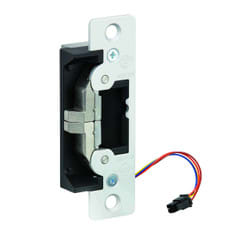
Adams Rite 1870-20-313 Standard Cylinder-Operated Flushbolt with Flat Faceplate in Dark Bronze
-
MPN: 1870-20-313
-
JMAC ID: 200485981
Adams Rite 1870-20-313 FLUSH BOLT
In order to minimize unintentional locking of the inactive leaf of paired doors, the 1870-20-313 series Flushbolt is specifically made for aluminum stile doors and is engineered for greater key control. It employs the same fundamental over-center action mechanism as MS pivoting bolt deadlocks. For the highest level of protection, it is suggested that it be installed at the top and bottom of an inactive door and paired with an MS1850S deadlock on the active door. Only after the hex-section bolt is positively locked or unlocked can the key be withdrawn, as a 360-degree spin of the key throws or retracts the bolt. Both the threshold and the header can be placed to lock it.
Function: Created in 1870 to replace the traditional flip-lever operated flush bolts, Building management has full control over the inactive leaf of two narrow stile aluminum doors thanks to cylinder-operated flush bolts. prevents unauthorized people from accidentally locking the inactive leaf. The basic over-center action mechanism is the same as that used by MS pivoting bolt deadlocks. For maximum security, it is advised to install deadbolts at the top and bottom of inactive doors along with an MS1850S MS deadlock on the open door. Installed to lock at header or threshold.
Operation: The hex-section bolt is thrown or retracted with a 360 rotation of the key. Only after the bolt is positively locked or unlocked can the key be removed. A normal 1" [25.4 mm] length, 1-5/32" [29.4 mm] diameter, MS cam-equipped mortise cylinder with MS cam, like the 4036 Mortise Cylinder, or a separate thumbturn, like the 4066 Thumbturn, are both compatible with the lock. The cylinder might come from either side or both.
Also known as: 187020313
For more information about the Adams Rite 1870-20-313, please contact us.
In order to minimize unintentional locking of the inactive leaf of paired doors, the 1870-20-313 series Flushbolt is specifically made for aluminum stile doors and is engineered for greater key control. It employs the same fundamental over-center action mechanism as MS pivoting bolt deadlocks. For the highest level of protection, it is suggested that it be installed at the top and bottom of an inactive door and paired with an MS1850S deadlock on the active door. Only after the hex-section bolt is positively locked or unlocked can the key be withdrawn, as a 360-degree spin of the key throws or retracts the bolt. Both the threshold and the header can be placed to lock it.
Function: Created in 1870 to replace the traditional flip-lever operated flush bolts, Building management has full control over the inactive leaf of two narrow stile aluminum doors thanks to cylinder-operated flush bolts. prevents unauthorized people from accidentally locking the inactive leaf. The basic over-center action mechanism is the same as that used by MS pivoting bolt deadlocks. For maximum security, it is advised to install deadbolts at the top and bottom of inactive doors along with an MS1850S MS deadlock on the open door. Installed to lock at header or threshold.
Operation: The hex-section bolt is thrown or retracted with a 360 rotation of the key. Only after the bolt is positively locked or unlocked can the key be removed. A normal 1" [25.4 mm] length, 1-5/32" [29.4 mm] diameter, MS cam-equipped mortise cylinder with MS cam, like the 4036 Mortise Cylinder, or a separate thumbturn, like the 4066 Thumbturn, are both compatible with the lock. The cylinder might come from either side or both.
Also known as: 187020313
Technical Specifications:
|
For more information about the Adams Rite 1870-20-313, please contact us.
- MS1880, MS1881 Two-Point Flushbolt Installation Instructions
- 1870 Cylinder-Operated Flushbolt Installation Instructions
- 1870HM Series Cylinder Operated Flushbolt Installation Instructions
- 1877 Cylinder-Operated Flushbolt for Wood Doors Installation Instructions
- B1921, B1923 Full Surface Reinvorcing Pivot Hinges Installation Instructions
Other products from Adams Rite


Customer Reviews
(No reviews yet)
Write a Review

